



NTNU Hosts Trilateral Winter School on Diplomacy and Public Policy
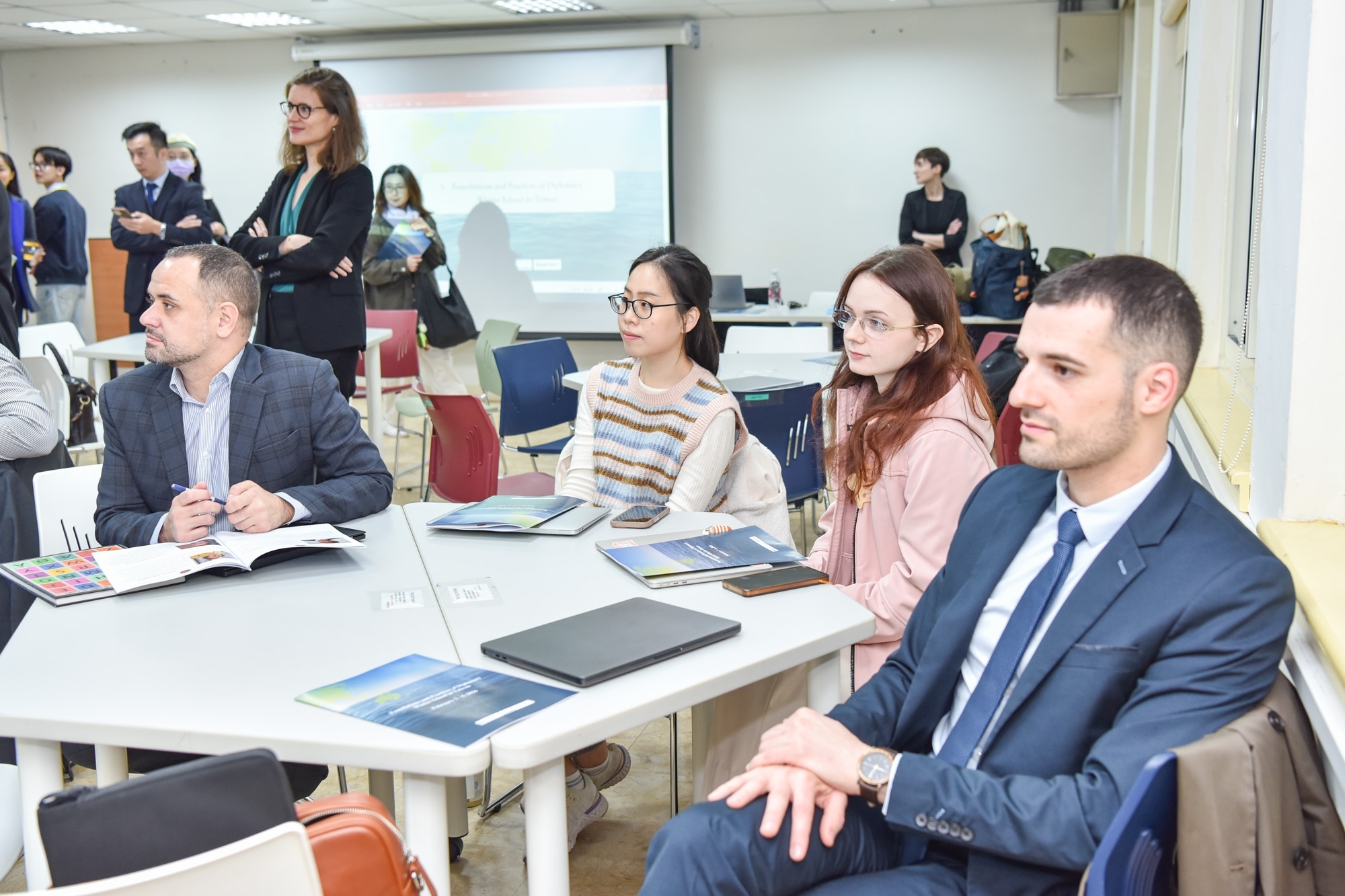
An intensive Winter School was held in Taipei from 2-6 February, attended by students and scholars from National Taiwan Normal University, France's Institut national des langues et civilisations orientales (Inalco), and Canada's École nationale d'administration publique (ÉNAP). Winter School participants came from three countries for a week of immersive academic exchange focused on diplomacy, international relations, and public policy practice.
The program was organized through NTNU's International Taiwan Studies Center. During her opening remarks on the first day, Center Director Nikky Lin reflected on the program's ambitions. Lin highlighted that the Winter School was a structured opportunity for students to encounter Taiwan's political and diplomatic realities firsthand through both expert instruction and direct access to the institutions that shape them.
The Winter School marked the fifth iteration of the 'Foundations and Practices of Diplomacy' initiative, which had previously convened in Montreal, Paris, Washington D.C., and Tokyo. Taipei was this initiative’s newest and most geopolitically resonant host city. Inalco President Jean-François Huchet underscored this point during the opening ceremony, noting that Taiwan occupies a uniquely consequential position in today's geopolitical landscape, and that situating the program here offered students an unparalleled window into the tensions and opportunities that define contemporary international relations in the Indo-Pacific. He expressed hope that participants would leave with a sharpened capacity to navigate different national and regional diplomatic perspectives.
The curriculum drew on a distinguished faculty from all three partner institutions. Huchet and Inalco Vice President Delphine Allès led sessions on diplomacy and international relations from a European vantage point, while ÉNAP Professor Stéphane Paquin contributed expertise in international political economy and Canadian foreign policy. Taiwan-based perspectives were provided by Dr. I-Chung Lai, President of the Prospect Foundation, who spoke on cross-strait relations and Taiwan's strategic environment, and Assistant Professor Sanho Chung of National Cheng Kung University, who addressed Taiwan's evolving role in regional and global affairs. Together, the faculty offered students a genuinely multilateral lens through which to examine some of the most pressing questions in contemporary diplomacy.
Beyond the lecture hall, the program brought in senior practitioners to ground theory in lived experience. Marie-Louise Hannan, representative of the Canadian Trade Office in Taipei, and William Stanton, former Director of the American Institute in Taiwan and currently a Distinguished Lecturer at NTNU, shared firsthand accounts of navigating Taiwan's distinctive international status. Their reflections on building effective working relationships gave students a candid look at the day-to-day realities of Taiwan’s unique diplomatic framework.
A highlight of the Winter School was a series of well-coordinated visits that gave participants direct access to Taiwan's political and diplomatic centers. At the Legislative Yuan, students engaged with legislators including Michelle Lin Chu-yin, Chair of the Inter-Parliamentary Amity Association, and Wu Pei-yi on issues of parliamentary diplomacy and Taiwan's domestic political dynamics. A working session with Deputy Minister François Wu Chih-chung offered frank discussion of the practical challenges Taiwan faces. Amb. Wu shared how Taiwan must be creative and persistent while conducting foreign relations at every level, since it must do so without formal recognition from most of the world's governments.
Participants also visited the French Office in Taipei, where Director Franck Paris, joined by Lutz Güllner of the European Economic and Trade Office, spoke about the work of advancing bilateral cooperation within the constraints of Taiwan's non-standard international standing. For many students, these conversations illustrated how much substantive diplomatic work unfolds outside the conventional state-to-state framework and how Taiwan has developed considerable expertise in operating within that space.
Exchanges extended well beyond the classroom. Participants joined local students for night market outings, karaoke evenings, and late-night street food. At the closing ceremony, several international students reflected that they had arrived with limited knowledge of Taiwan and left with a substantially fuller understanding of its diplomatic predicament and political vitality. Many expressed a desire to continue advocating for broader international awareness of Taiwan upon returning home, describing themselves as newly committed ambassadors for the island.
For NTNU, the Winter School represents a meaningful step in deepening institutional ties with leading universities in France and Canada, and in establishing Taiwan as a compelling and intellectually serious site for international dialogue on public policy and global affairs. With the partnership now well into its fifth year, the three institutions look ahead to expanding the program's reach and continuing to offer participants a richer, more grounded understanding of diplomacy as it is actually practiced in one of the world's most complex geopolitical environments.