

NTNU AI Education Research Expertise Supports Taipei City’s AI Education Policy White Paper
Advancing a Human-Centered, Ethics-First, Learning-Driven Blueprint for an AI Education City
As artificial intelligence (AI) rapidly enters educational settings, Distinguished Professor Ting-Chia Hsu of the Department of Technology Application and Human Resource Development at National Taiwan Normal University (NTNU), who also serves as Director of the Division of Logic and Programming Education in NTNU’s Office of Academic Affairs, delivered introductory remarks at the launch event for the Taipei City AI Education Policy White Paper on July 3, 2026, in her capacity as editor-in-chief of the White Paper. Professor Hsu highlighted an important policy shift: AI education is moving from tool adoption to systemic governance, and from isolated applications to city-level educational infrastructure. She noted that AI is no longer merely a new classroom tool; it is reshaping how teachers prepare lessons, design materials, provide assessment feedback, and how students ask questions, explore knowledge, and create. The core purpose of AI in education, she emphasized, is not to pursue technological novelty, but to deepen learning outcomes across subject areas and interdisciplinary learning contexts.
The Taipei City AI Education Policy White Paper is grounded in the principles of being human-centered, ethics-first, and learning-driven. It positions AI as a form of public educational infrastructure that supports teacher professionalism, deepens student learning, improves administrative efficiency, enhances campus environments, and promotes home-school co-education. The White Paper states that AI education has moved beyond the early stage of individual tool use toward platform-based, system-oriented, data-driven, and governance-focused development. Under the premises of safety, ethics, effectiveness, and governability, AI can support more personalized, timely, and inclusive learning environments.
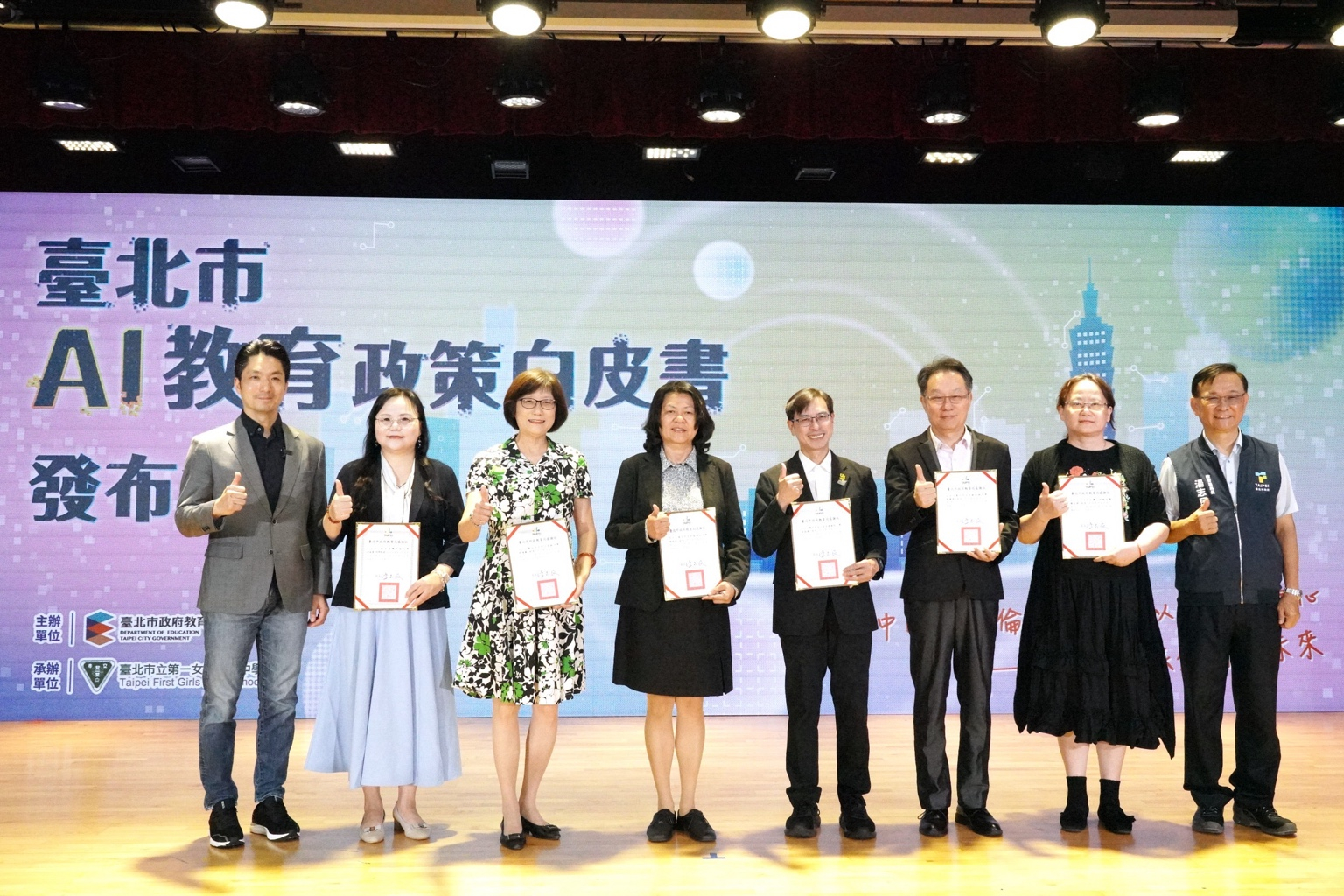
Group photo at the Taipei City AI Education Policy White Paper launch event, highlighting the shared vision of educational administration, schools, and academia in advancing an AI education city.
Professor Hsu stated that the real question in AI education is no longer whether AI should be used, but how it can be used under conditions that are safe, ethical, effective, and governable. Drawing on international trends in Korea, Japan, Singapore, the European Union, the United States, Australia, and the work of the OECD and UNESCO, she observed that AI education is no longer simply a matter of offering AI courses or allowing students to use generative AI. Rather, it concerns how an education system can build a complete smart education ecosystem across platforms, devices, curricula, teachers, students, administration, families, and governance.
The White Paper particularly emphasizes that, however powerful AI may become, it cannot replace the human dimension of education. AI can assist teachers, support students, and improve administrative efficiency, but it cannot replace teachers’ professional judgment, students’ independent thinking, or the educational responsibilities of families and schools. Accordingly, the central goal of Taipei City’s AI education policy is to cultivate a smart education culture that is human-centered, ethics-first, and learning-driven.
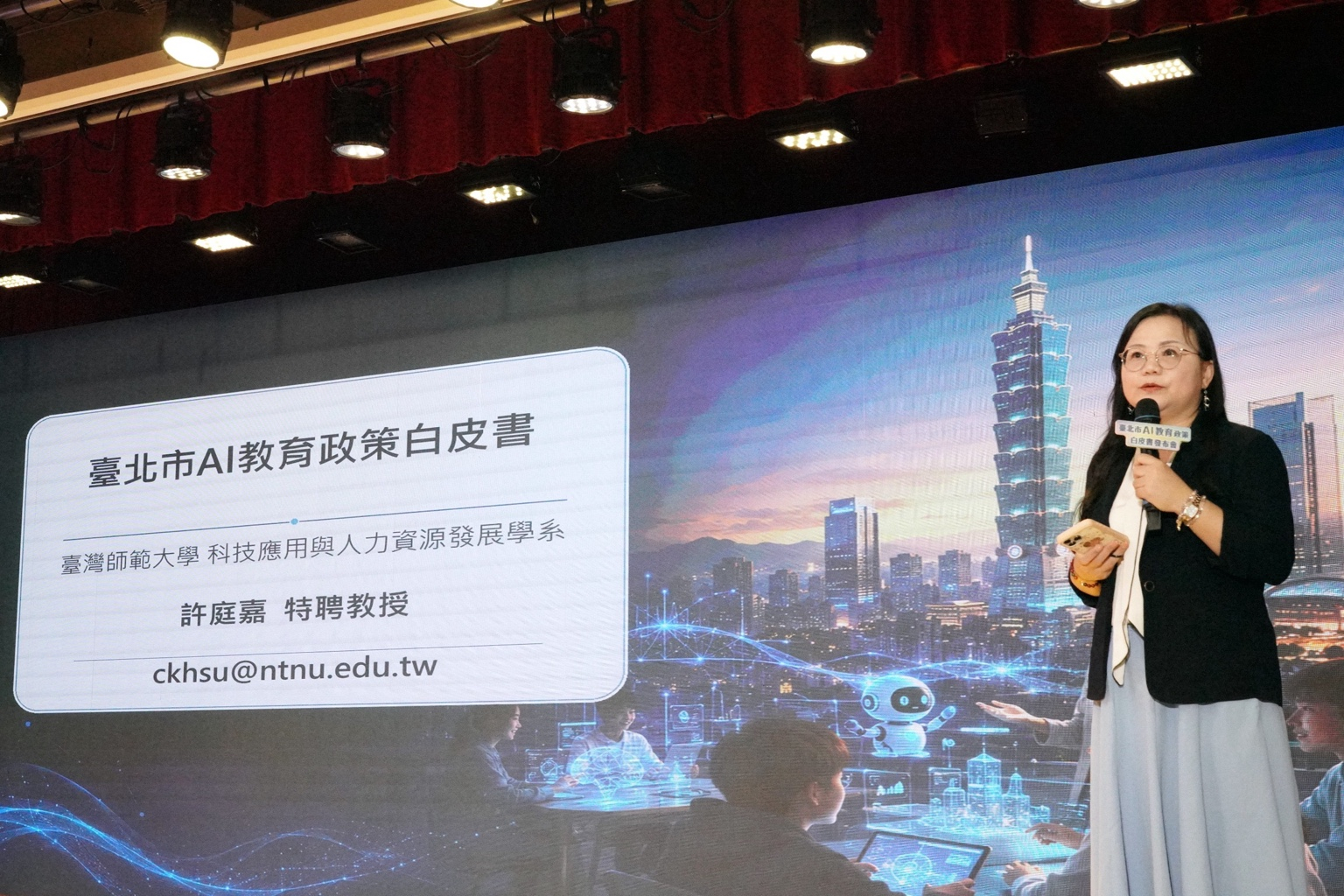
Distinguished Professor Ting-Chia Hsu of NTNU’s Department of Technology Application and Human Resource Development explains the Taipei City AI Education Policy White Paper at the launch event and analyzes the trend of AI education from tool adoption toward educational infrastructure.
In its policy framework, the White Paper uses Taipei CooC Cloud, the CooAI intelligent learning system, and city-level data governance as a stable foundation, while preserving professional autonomy for schools and teachers to explore diverse AI tools according to their instructional needs. In other words, the city-level authority is responsible for safety, scale, and governance, while schools are responsible for innovation, practice, and pedagogical transformation. Together, these elements form a model of city-level platform stability and school-level flexible innovation.
The White Paper also identifies AI literacy for parents, teachers, and students as a core element of policy implementation. For teachers, AI literacy means transforming AI into a support tool for lesson preparation, instructional design, differentiated guidance, assessment feedback, and professional growth. For students, AI literacy emphasizes understanding AI, using AI effectively, and collaborating with AI responsibly. This includes AI ethics, AI foundations and technologies, AI system design, and AI-enabled learning. For parents, AI literacy helps them understand the contexts and risks of children’s AI use, establish appropriate family digital guidelines, and make AI a positive force for children’s development through parent-child co-learning and home-school collaboration.
In terms of overall policy direction, the White Paper proposes five major educational blueprints: Empowering Smart Education and Ethical Literacy; Smart Administrative Governance and Data-Driven Decision-Making; AI-Powered Smart and Sustainable Campuses and Infrastructure; Public-Private Partnerships and an Industry Co-Prosperity Ecosystem; and Lifelong Co-Learning and Family Digital Parenting. Together, these five blueprints form an integrated transformation framework that spans curriculum and literacy, administration and governance, network platforms and learning spaces, industry-academia collaboration and talent cultivation, and family-school co-education. The framework extends from classrooms and campuses to families, the city, and industry.
The White Paper sets 2027 to 2030 as the key implementation period. The year 2027 will focus on institutional foundations and pilot initiatives; 2028 will emphasize deeper application and stable dissemination; 2029 will move toward cross-school integration and system expansion; and 2030 will aim for innovative transformation and sustainable maturity. Professor Hsu explained that this means AI education is not a one-time tool introduction. Rather, over a four-year period, Taipei City will guide AI education from pilots to dissemination, integration, mature governance, and sustainable development.
NTNU has long been committed to teacher education, educational technology, digital learning, and AI literacy research. The participation of an NTNU scholar in interpreting and promoting the AI Education Policy White Paper demonstrates the university’s academic responsibility in educational policy, technology application, and future talent development. Looking ahead, NTNU will continue to build on research-based foundations, integrating teacher professional development, student AI literacy, parent digital parenting, and education governance to support schools as they respond to the challenges and opportunities of the generative AI era.
Professor Hsu emphasized that the goal of AI education is not merely successful technology adoption, but a redefinition of the essence of education. In the age of artificial intelligence, education should cultivate lifelong learners who can collaborate with AI while exercising value judgment and creativity. AI should become an important partner that accompanies children as they deepen learning, explore the world, and create the future, rather than a tool that replaces human judgment and educational relationships.
Related Video / News Link
Taipei City AI Education Policy White Paper Launch Event Livestream: https://www.youtube.com/live/CNwNcZ2q6qU?si=MtDkIEsFLMDtGeL_
.jpg)
Professor Hsu emphasizes that AI should not replace teachers, but should support teacher professionalism, deepen student thinking, and make education safer, fairer, and more humane.

Each launch pillar corresponds to one of the five major blueprints: Empowering Smart Education and Ethical Literacy; Smart Administrative Governance and Data-Driven Decision-Making; AI-Powered Smart and Sustainable Campuses and Infrastructure; Public-Private Partnerships and an Industry Co-Prosperity Ecosystem; and Lifelong Co-Learning and Family Digital Parenting. Together, they form the overall implementation framework for an AI education city.
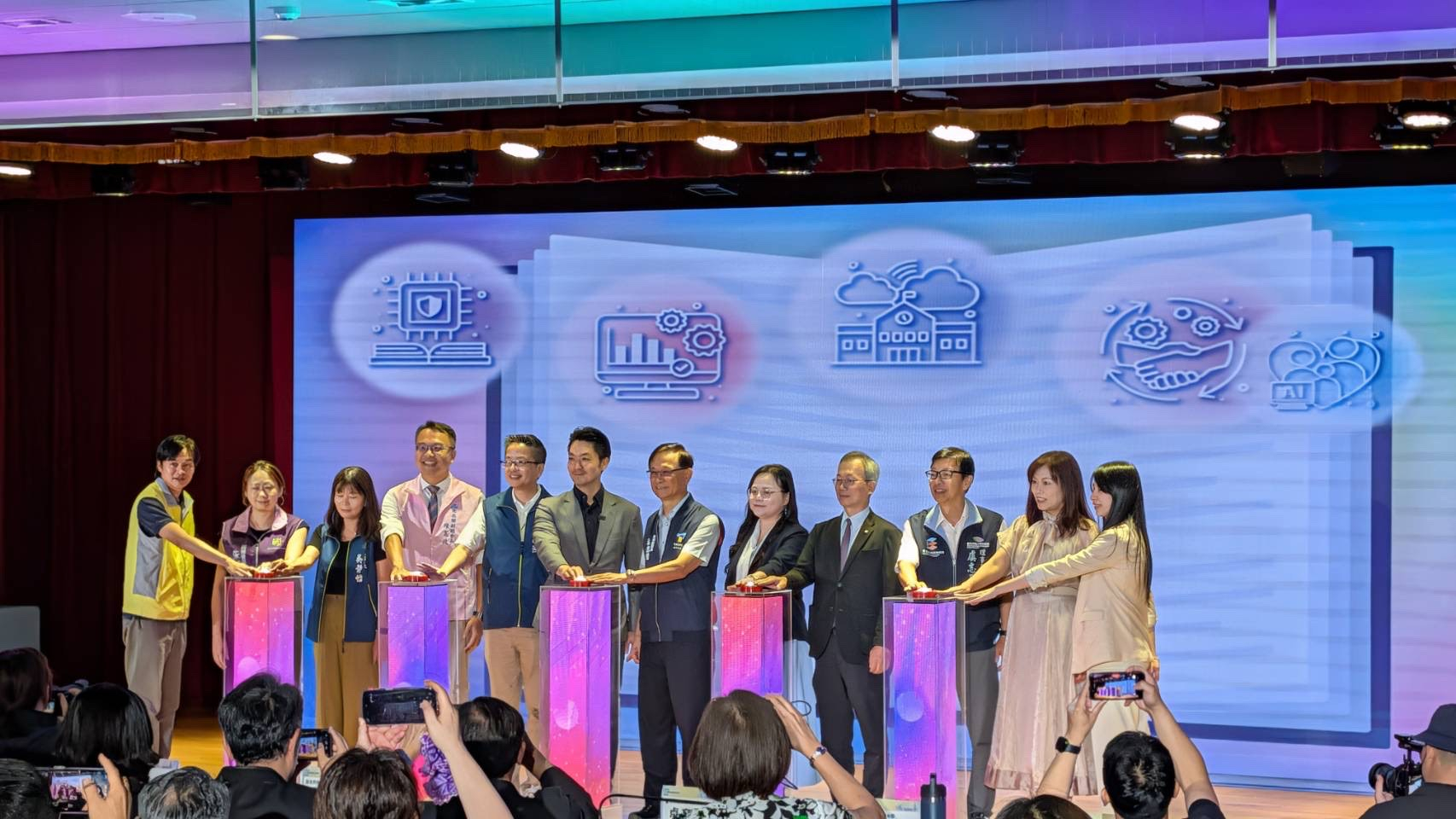
Launch ceremony for the five AI education blueprints.