


NTNU Partners with the University of Glasgow to Launch International Sustainable Leadership Programme
National Taiwan Normal University (NTNU) is strengthening its international collaboration on sustainability through a new partnership with the University of Glasgow. In June 2026, the two universities launched the International Sustainable Leadership Programme, bringing together 45 undergraduate and postgraduate students from eight NTNU colleges to study at the University of Glasgow's Dumfries Campus. Students who successfully completed the programme and its assessments were awarded three NTNU academic credits, underscoring the University's commitment to bilingual education, international mobility and sustainable development.
In recent years, NTNU has advanced its bilingual benchmark university initiative, internationalisation efforts and university social responsibility agenda. The University has also received additional funding from Ministry of Education under the Program on Bilingual Education for Students in College (BEST) as one of the country's designated benchmark universities. According to the 2026 Times Higher Education (THE) Impact Rankings, released on 24 June, NTNU rose to the 101–200 band globally, marking its strongest performance to date. Building on this momentum, NTNU's Office of International Affairs has continued to deepen collaboration with strategic partner universities. The programme also builds on the International Sustainability Winter School held in January 2026, which brought together NTNU, the University of Glasgow and Kyushu University to foster international collaborative learning before extending that experience into an overseas learning environment.
The programme brought together 45 students from across the University, including 12 from the College of Education, 11 from the College of Liberal Arts, 10 from the College of International Studies and Social Sciences, five from the College of Science, two each from the College of Technology and Engineering, the College of Sports and Recreation, and the College of Management, and one from the College of Arts. Through lectures, seminars and field-based learning at the Dumfries Campus, participants from diverse academic backgrounds explored the challenges and opportunities of sustainable development from a wide range of disciplinary perspectives.
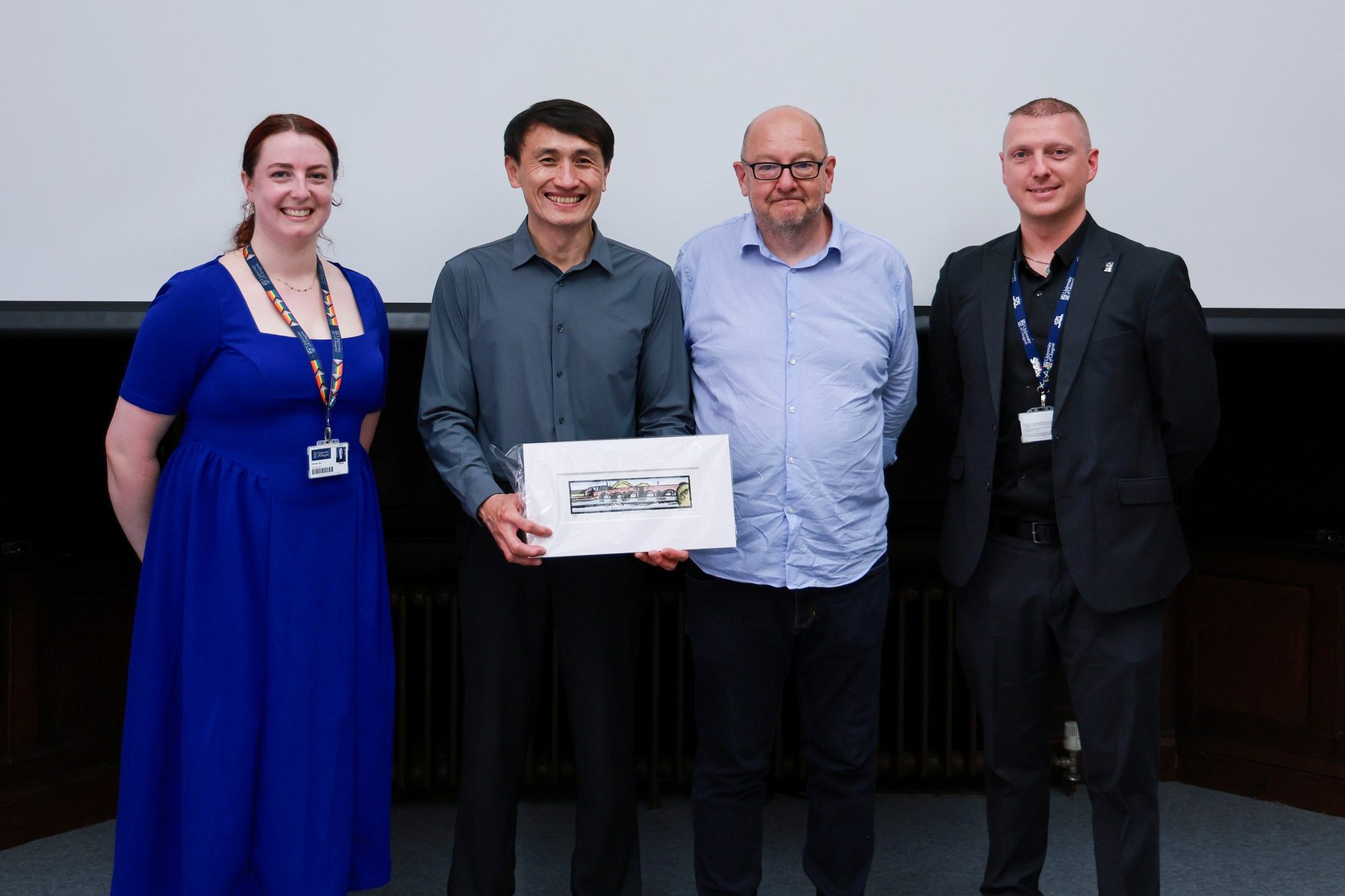
Speaking at the opening ceremony, Dr Yi-Te Liu, Vice President for International Affairs at NTNU, reflected on his own experience of studying abroad as he encouraged students to make the most of the opportunity. He said he hoped the programme would broaden their international outlook, open up new possibilities for their future careers, and equip them with a wider global perspective. He also expressed his sincere appreciation to the University of Glasgow for its partnership and said he looked forward to strengthening academic collaboration and exchanges between the two institutions.
Professor Douglas Shand, who designed the programme, spoke highly of the performance of NTNU students, saying: 'The world today faces increasingly complex challenges, and we need a new generation of leaders who think differently and act differently. The critical thinking skills and eagerness to learn demonstrated by the students from Taiwan throughout the programme have been truly impressive.'
Over the course of the ten-day programme, students were taught by leading academics from the University of Glasgow. The first half of the programme focused on the foundations of leadership and decision science.
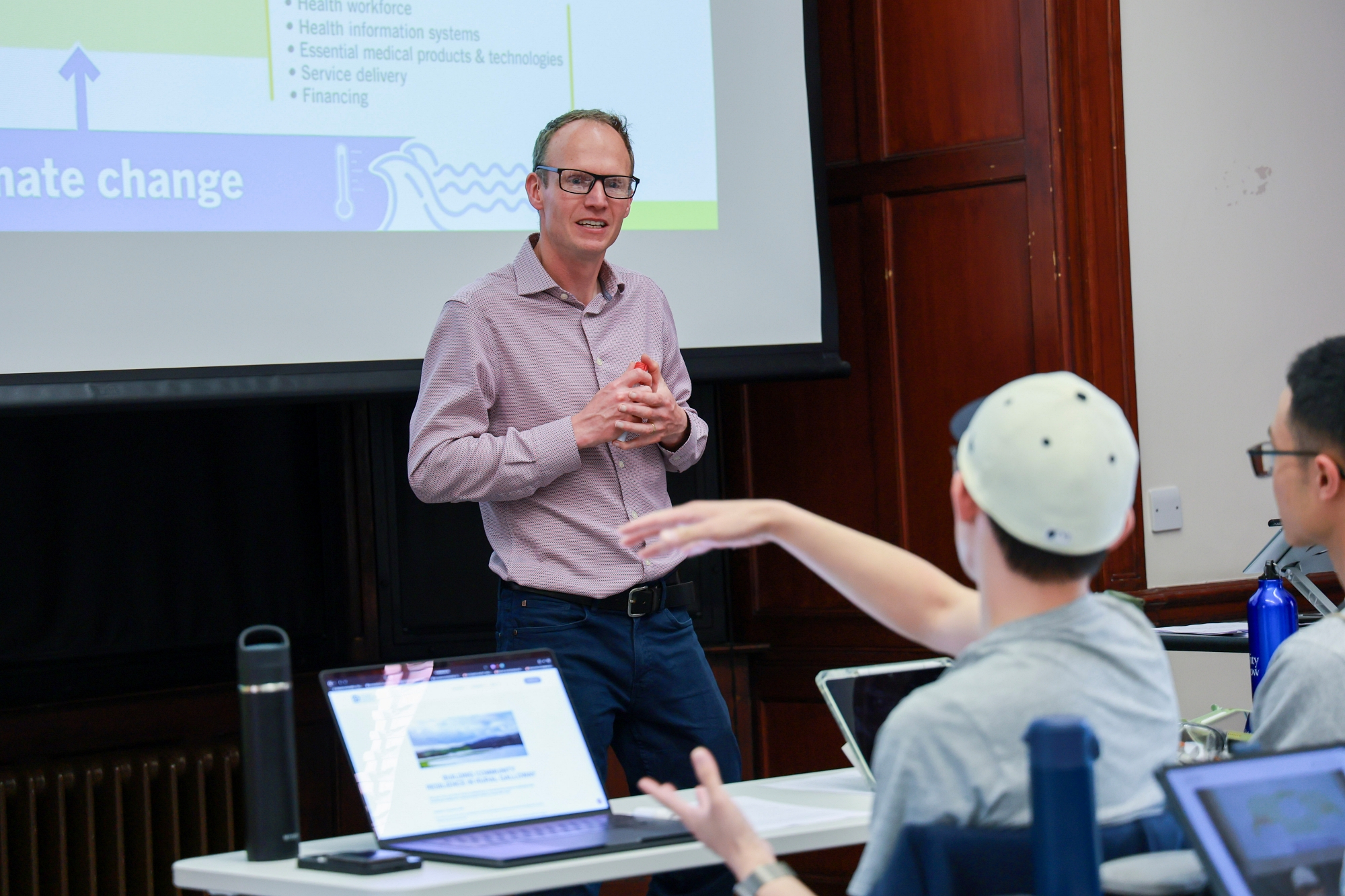
Professor Douglas Shand began by inviting students to reconsider the responsibilities of organisations, examining the shift from the traditional concept of Corporate Social Responsibility (CSR) to the more comprehensive Environmental, Social and Governance (ESG) framework for sustainable management. He emphasised that effective leadership requires balancing short-term objectives with long-term social impact.
The programme also drew on perspectives from political economy. Professor David Clelland explored the effects of globalisation on regional development and invited students to consider how regional leaders can move beyond an exclusive focus on economic growth by making better use of local resources and regional strengths to promote more resilient regional revitalisation and sustainable regional development.
Global public issues also formed a key part of the curriculum. Professors Alistair Hunter and Sandy Whitelaw used the climate and health crisis as a case study, encouraging participants to adopt a whole-systems approach when examining complex policy challenges such as extreme weather, food insecurity and community resilience. They also considered how communities can strengthen their capacity to respond to natural disasters and environmental change.
The programme also drew on perspectives from anthropology. Professors Naomi Richards and Marian Krawczyk invited students to question the conventional Western distinction between nature and culture. Through case studies of land rights among the Inuit in Canada and the Western Apache, participants explored how Indigenous communities integrate cultural values into environmental governance and develop locally grounded approaches to ecological stewardship.
The final part of the programme focused on sustainable development in Scotland. Drawing on examples from areas facing increasing tourism pressures, including Edinburgh's Old Town and the Isle of Skye, Professor Gokce Ozdemir Umutlu examined how low-carbon transport, renewable energy and digital visitor management systems can help strike a balance between net-zero ambitions, tourism development and the carrying capacity of local communities.
Learning extended well beyond the classroom, as the programme transformed academic concepts into hands-on learning through a series of field visits across Scotland. Students visited Edinburgh Zoo, took part in a beach clean-up, and explored a local wild forest restoration project, gaining first-hand insight into how different communities respond to environmental challenges through biodiversity conservation, community engagement and practical sustainability initiatives.
During the visit to the forest restoration project, Andy, one of the project's founders, shared how local residents had come together to establish a charitable organisation after witnessing the continued degradation of the surrounding landscape. Their collective efforts have since transformed the site into an important centre for ecological education and community engagement, offering students a powerful example of how meaningful sustainability initiatives can grow from local action and long-term commitment.
Participants spoke highly of the programme, highlighting both NTNU students' global outlook and their strong sense of social responsibility.
Chang Chia-Wen, a student from NTNU's Graduate Institute of European Cultures and Tourism, said sustainability should never be seen as the responsibility of a single discipline. She explained that bringing together students from different academic backgrounds had sparked fresh ideas and inspiring discussions throughout the programme.
'Everyone came from a different background, and our understanding of sustainability naturally varied. But once we were here, we shared the same aspiration to make the world a better place. By speaking openly and exchanging our ideas, I truly believe we can make a positive difference.'
Yao Hsin-Jen, a student from the Department of English (Class of 118), said the programme's international and comparative perspective left the strongest impression on him. He noted that the course was highly interdisciplinary, with a clear and well-defined academic focus. After attending sessions on environmental sustainability and overtourism, he particularly appreciated the lecturers' practical and evidence-based approach. Rather than presenting idealised solutions, they encouraged students to engage with the complexity of real-world challenges and consider how sustainable solutions can be developed in practice.
The summer programme concluded successfully, marking another milestone in the growing partnership between NTNU and the University of Glasgow. In addition to strengthening the close relationship between the two partner universities, the programme has laid a solid foundation for future joint courses, student mobility and collaborative research in sustainability. Guided by the United Nations Sustainable Development Goals (SDGs), NTNU will continue to advance sustainable governance, strengthen teaching and research, promote interdisciplinary collaboration and social engagement, and enhance its global academic impact as it works towards becoming a university with worldwide influence in sustainability.