

NTNU AI Speech Research Accepted at EMNLP 2026, Bringing Low-Resource Speech Technology into Education
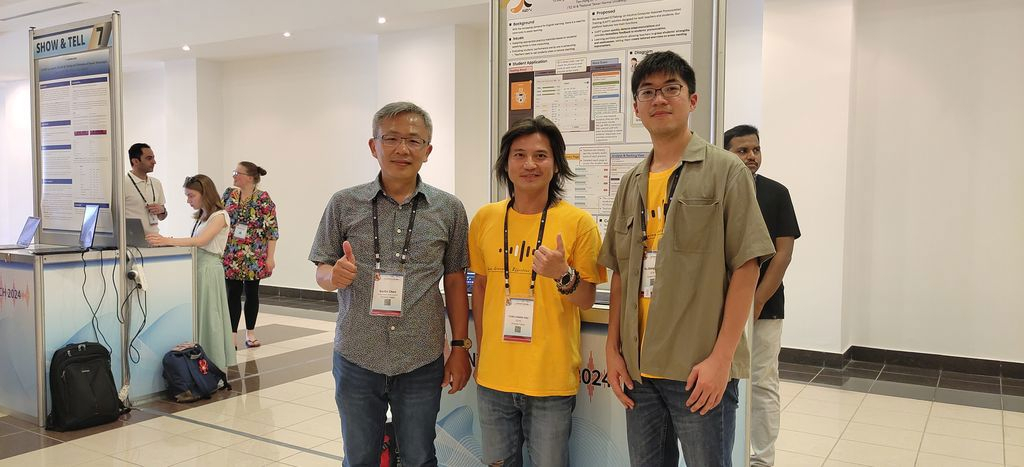
As generative artificial intelligence continues to advance, speech recognition and natural language processing are being increasingly applied in education, healthcare, long-term care, and smart services. At National Taiwan Normal University (NTNU), Professor Berlin Chen of the Department of Computer Science and Information Engineering and Assistant Professor Hung-Shin Lee of the Graduate Institute of AI Interdisciplinary Applied Technology have collaborated with Taiwan-based AI speech technology company EZAI on a study that has been accepted as a long paper at EMNLP 2026, a major international conference in natural language processing.
Focusing on low-resource speech recognition, the study combines academic research with industry expertise to explore practical applications of speech AI, particularly in education and other data-limited settings.
Improving Speech Recognition with Limited Data
The NTNU–EZAI team focused on low-resource speech recognition, particularly for languages with limited training data. Compared with languages such as English, Taiwanese and Hakka have relatively limited high-quality speech resources, posing greater challenges for the accuracy and generalizability of speech recognition models.
To address this challenge, the team tested its SAMA-ASR model using only about 30 hours of speech data. The model was designed to improve speech recognition performance under data-limited conditions. Its acceptance as a long paper at EMNLP 2026 also highlights the potential of speech AI research to support local languages, education, and other applications.
Professor Chen emphasized that AI research should not focus solely on improving model performance. Equally important is applying AI to challenges across different fields and developing solutions that respond to real-world needs. NTNU will continue to promote interdisciplinary collaboration, bringing AI together with education, the humanities, culture, and industry. Through these efforts, the university aims to move AI research beyond the laboratory and develop practical applications for real-world settings.
Professor Lee noted that speech AI requires large amounts of representative data to handle different languages, accents, and contexts, making low-resource speech recognition an important area of research. He added that collaboration between academia and industry can help turn research findings into practical technologies and expand the impact of AI.
Bringing Speech AI into Education
NTNU’s collaboration with EZAI extends beyond academic research to the use of speech AI in education, exploring new ways for artificial intelligence to support language learning.
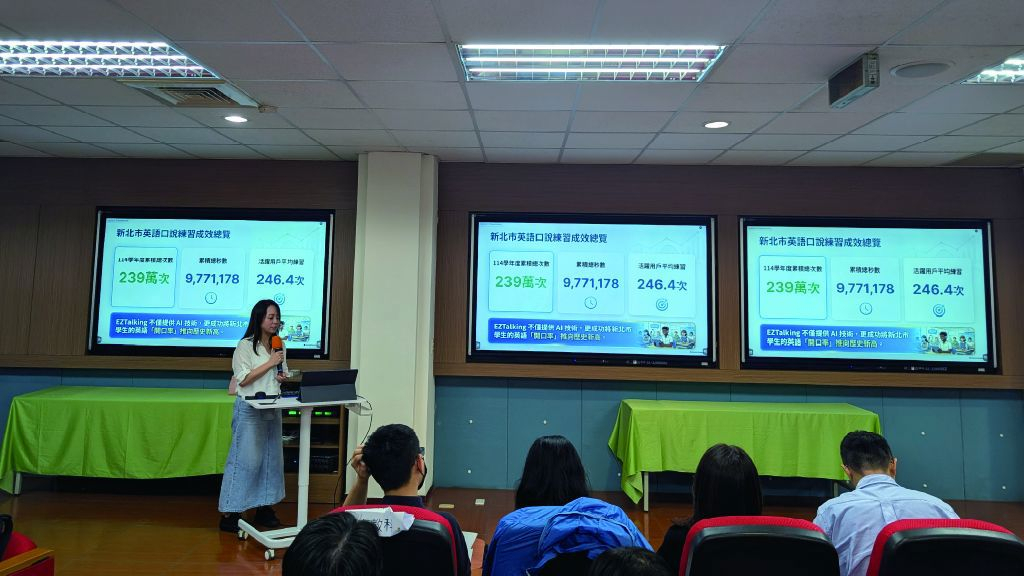
EZAI’s AI-powered speaking platform, EZTalking, has been used for English learning in schools, with more than 180,000 users. According to implementation data from schools in New Taipei City, usage continued to grow from 2022 to 2025, reaching 2.39 million uses in 2025. The figures point to the potential of speech AI for large-scale educational applications.
Using speech recognition and AI analysis, the platform provides immediate feedback on students’ pronunciation, helping learners identify areas for improvement and develop their speaking skills through continued practice. More recently, EZTalking has introduced an AI virtual teacher and a Free Talking function, allowing students to engage in two-way conversations with AI and creating more opportunities for independent practice and language use.
For NTNU, the collaboration is not simply about turning research into commercial products. More importantly, it creates a cycle connecting research, technology, and the classroom. Feedback and needs from real educational settings can inform further research and technological improvements, helping ensure that AI development responds to challenges encountered in education.