



2026.1025
Asia-Pacific Scholars Gather at NTNU’s APRN Workshop to Advance Plant Technology, Ecological Resilience and Wetland Conservation
National Taiwan Normal University (NTNU) hosted the AP-Plant Resilience Network (APRN) International Workshop on October 23, bringing together ten scholars from nine countries and regions across Asia to explore how plant technology can address climate change, biodiversity conservation, and global food security. The workshop featured three thematic sessions: ecological conservation and environmental restoration, plant biotechnology for sustainable agriculture, and supramolecular chemistry and coordination materials.
NTNU President Yao-Ting Sung welcomed the international participants and emphasized the importance of cross-border and interdisciplinary collaboration in advancing research, student exchanges, and sustainable development.
President Sung calls for international research collaboration with real-world impact
Organized by NTNU’s College of Science with support from Taiwan’s National Science and Technology Council (NSTC), the workshop brought together researchers from South Korea, Japan, Hong Kong, India, Indonesia, Malaysia, the Philippines, Thailand and Vietnam. The event was held in a hybrid format, allowing scholars from the University of Osaka, an NTNU partner institution, to participate remotely.
In his opening remarks, President Sung noted that ecological challenges and food security extend beyond national borders. Crop failures in one region can affect food prices elsewhere, while the loss of coastal mangroves can disrupt migratory bird habitats across countries. Plants and wetlands play essential roles in food production, carbon storage, coastal protection and biodiversity conservation.
Sung stressed that addressing these interconnected challenges requires international cooperation among scientists and policymakers. He also emphasized that NTNU’s commitment to teacher education extends to translating research findings into teaching, community engagement and practical solutions. He expressed hope that the workshop would lead to joint research projects, student exchanges and lasting international partnerships.
NTNU College of Science Dean Jein-Shan Chen welcomed the participants and highlighted the workshop’s three research themes: ecological conservation and environmental restoration, plant biotechnology for sustainable agriculture, and supramolecular chemistry and coordination materials.
International researchers share advances in conservation, agriculture and materials science
The workshop featured ten international scholars presenting research across three themes: ecological conservation and environmental restoration, plant biotechnology for sustainable agriculture, and supramolecular chemistry and coordination materials.
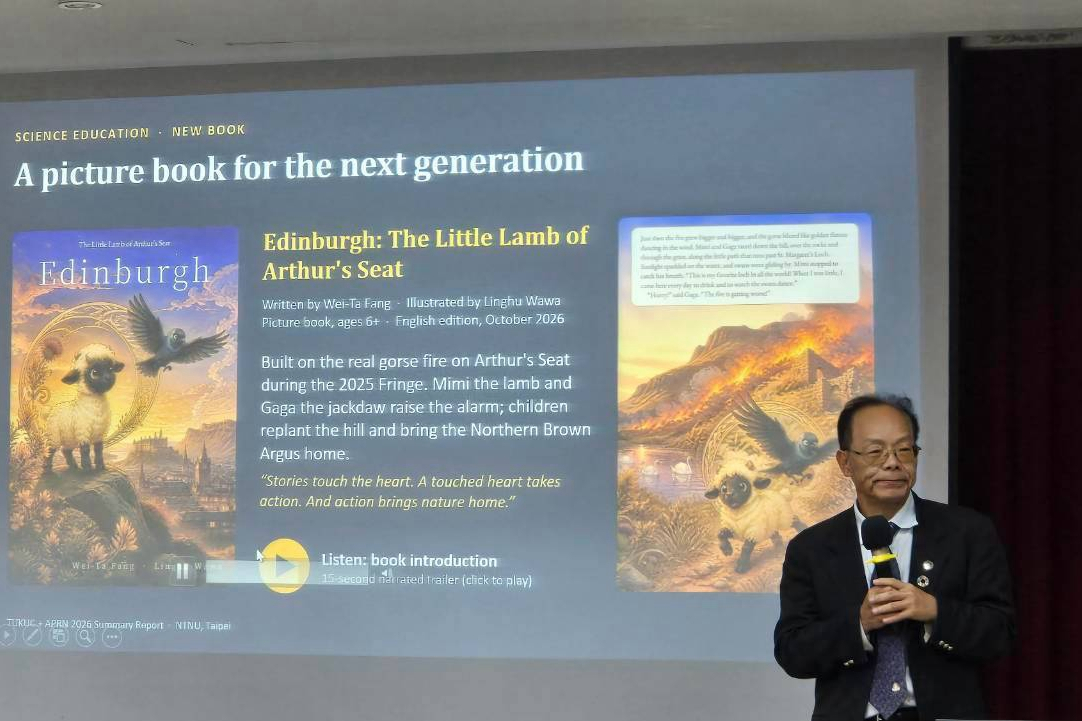
Distinguished Professor Wei-Ta Fang of NTNU’s Graduate Institute of Sustainability Management and Environmental Education served as the project’s principal investigator and chair of the workshop organizing committee. Drawing on the August 2025 wildfire at Arthur’s Seat in Edinburgh, Scotland, Fang highlighted the potential of plant biotechnology in ecological restoration. He explained how plant genomics and tissue culture-based micropropagation could help identify and propagate native species with greater drought and fire resilience, supporting the recovery of damaged habitats.
Beyond academic presentations, the workshop incorporated interdisciplinary art installations exploring themes of ecological coexistence and transformation. Through mixed media and traditional bamboo weaving, the works connected scientific research with artistic expression, encouraging greater public awareness of climate change and environmental conservation.
Wetland conservation and soybean genomics highlight sustainable development
In the morning keynote, Suh Seung-Oh, Executive Director of the Ramsar Regional Center–East Asia, discussed wetland conservation and the Convention on Wetlands’ Communication, Capacity Building, Education, Participation and Awareness (CEPA) programme.
Suh explained that wetland conservation has evolved from an emphasis on waterbird habitats toward a broader ecosystem-based approach that balances environmental protection with human needs. He stressed the importance of connecting scientific knowledge with everyday life and encouraging public participation through education, social media and accessible communication.
The afternoon keynote was delivered by Professor Hon-Ming Lam, Choh-Ming Li Professor of Life Sciences and Director of the State Key Laboratory of Agrobiotechnology at The Chinese University of Hong Kong. He examined advances in soybean genomics and their applications in sustainable agriculture. Lam reviewed his team’s pioneering research, including the whole-genome resequencing of 17 wild and 14 cultivated soybean accessions in 2010, which revealed greater genetic diversity in wild soybeans. The findings were featured on the cover of Nature Genetics. In 2014, his team identified and cloned the salt-tolerance gene GmCHX1 from wild soybean, publishing the findings in Nature Communications.
In 2019, the team completed the first reference-grade wild soybean genome assembly, further advancing soybean genomic research. Lam also discussed the development of non-genetically modified soybean varieties with improved salt and drought tolerance through collaboration with agricultural researchers in Gansu Province, China.
The resulting Longhuang soybean varieties have been cultivated on more than 40,000 hectares of marginal land in northwestern China as of 2021, with seeds provided to farmers free of charge. Lam’s international collaborations have also extended to South Africa and Pakistan, demonstrating how genomic research can support climate-smart agriculture and food security.
Plant propagation and molecular synthesis offer new research directions
During the plant biotechnology session, Pham Hong Diep, a lecturer at International University, Vietnam National University Ho Chi Minh City, presented research on tissue culture and propagation of Aquilaria crassna, a threatened agarwood-producing tree species.
Her team developed a micropropagation system using somatic embryogenesis, protocorm-like bodies (PLBs) and synthetic seed technologies to support germplasm conservation and sustainable utilization. Tissue-cultured plants have shown promising growth in nursery trials in Phu Quoc, Thu Duc and Binh Phuoc. A group of six-year-old tissue-cultured trees in Binh Phuoc also successfully produced agarwood following fungal induction.
In the supramolecular chemistry session, Professor Chutima Kuhakarn of Mahidol University, Thailand, presented research on bioactive molecules derived from plant diversity. She explained that many naturally occurring compounds with potential medicinal applications are present in plants at extremely low concentrations, making large-scale extraction difficult.
Her team develops environmentally friendly synthetic methods to prepare natural products, small molecules and structural analogues. By examining relationships between molecular structure and biological activity, the research contributes to the development of new compounds and potential applications.
NTNU early-career researcher presents findings on blue carbon and methane emissions
The workshop also featured flash presentations by early-career researchers, including Tri Ngearnlek, a second-year doctoral student at NTNU’s Graduate Institute of Sustainability Management and Environmental Education. Ngearnlek presented research on blue carbon storage and greenhouse gas emissions in ASEAN coastal ecosystems, with findings published in the international journal Wetlands.
The study estimated that approximately 7.26 million hectares of mangroves and seagrass beds across ASEAN countries store around 853 million tonnes of carbon in their soils. However, methane emissions from delta ecosystems could offset 50% to 80% of the climate benefits of carbon sequestration, underscoring the need to account for methane emissions in blue carbon policies.
Ngearnlek emphasized the importance of integrating scientific research with sustainable management strategies to maximize the environmental and economic benefits of blue carbon ecosystems.
Another early-career presenter, Roaa Khaled Saad Mohamed Atia, an Egyptian master’s student at the University of Osaka’s Coordination Chemistry Laboratory, introduced research on novel palladium complexes synthesized using the naturally occurring sulfur-containing amino acid homocysteine.
By combining these complexes with manganese ions, her research produced a homocysteine-based coordination polymer, with its structure confirmed through single-crystal X-ray diffraction. The findings demonstrated potential directions for research in supramolecular chemistry and coordination materials.
The APRN workshop brought together researchers working across environmental science, agricultural biotechnology and chemistry, strengthening NTNU’s academic connections throughout the Asia-Pacific region. Through international collaboration and opportunities for emerging scholars, NTNU aims to translate interdisciplinary research into practical approaches to ecological resilience, wetland conservation and sustainable development.